
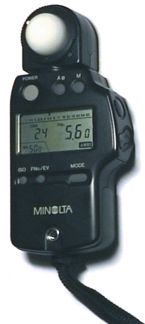
A light meter is a device used to measure the amount of light. In photography, a light meter is often used to determine the proper exposure for a photograph. Typically a light meter will include a computer, either digital or analogue, which allows the photographer to determine which shutter speed and f-number should be selected for an optimum exposure, given a certain lighting situation and film speed.
The earliest type of light meters were called extinction meters and contained a numbered or lettered row of neutral density filters of increasing density. The photographer would position the meter in front of their subject and note the filter with the greatest density that still allowed incident light to pass through. The letter or number corresponding to the filter was used as an index into a chart of appropriate aperture and shutter speed combinations for a given film speed.
Extinction meters suffered from the problem that they depended on the light sensitivity of the human eye (which can vary from person to person) and subjective interpretation.
Later meters removed the human element and relied on technologies incorporating selenium, CdS, and silicon photodetectors.


Selenium and silicon light meters use sensors that are photovoltaic: they generate a voltage proportional to light exposure. Selenium sensors generate enough voltage for direct connection to a meter; they need no battery to operate and this made them very convenient in completely mechanical cameras. Selenium sensors however cannot measure low light accurately (ordinary lightbulbs can take them close to their limits) and are altogether unable to measure very low light, such as candlelight, moonlight, starlight etc. Silicon sensors need an amplification circuit and require a power source such as batteries to operate. CdS light meters use a sensor based on photoresistance, i.e. their electrical resistance changes proportionately to light exposure. These also require a battery to operate. Most modern light meters use silicon or CdS sensors. They indicate the exposure either with a needle galvanometer or on an LCD screen.
Many modern consumer still and video cameras include a built-in meter that measures a scene-wide light level and are able to make an approximate measure of appropriate exposure based on that. Photographers working with controlled lighting and cinematographers use handheld light meters to precisely measure the light falling on various parts of their subjects and use suitable lighting to produce the desired exposure levels.
There are two general types of light meters: reflected-light and incident-light. Reflected-light meters measure the light reflected by the scene to be photographed. All in-camera meters are reflected-light meters. Reflected-light meters are calibrated to show the appropriate exposure for "average" scenes. An unusual scene with a preponderance of light colors or specular highlights would have a higher reflectance; a reflected-light meter taking a reading would incorrectly compensate for the difference in reflectance and lead to underexposure. Badly underexposed sunset photos are common exactly because of this effect: the brightness of setting sun fools the camera's light meter and, unless the in-camera logic or the photographer take care to compensate, the picture will be grossly underexposed and dull.
This pitfall is avoided by incident-light meters which measure the amount of light falling on the subject using an integrating sphere (usually, a translucent hemispherical plastic dome is used to approximate this) placed on top of the light sensor. Because the incident-light reading is independent of the subject's reflectance, it is less likely to lead to incorrect exposures for subjects with unusual average reflectance. Taking an incident-light reading requires placing the meter at the subject's position and pointing it in the general direction of the camera, something not always achievable in practice, e.g., in landscape photography where the subject distance approaches infinity.
Another way to avoid under- or over-exposure for subjects with unusual reflectance is to use a spot meter: a reflected-light meter that measures light in a very tight cone, typically with a one degree angle. An experienced photographer can take multiple readings over the shadows, midrange and highlights of the scene to determine optimal exposure, using systems like the Zone System. Many modern cameras include sophisticated multi-segment metering systems that measure the luminance of different parts of the scene to determine the optimal exposure. When using a film whose spectral sensitivity is not a good match to that of the light meter, for example orthochromatic black-and-white or infrared film, the meter may require special filters and re-calibration to match the sensitivity of the film.
There are other types of specialized photographic light meters. Flash meters are used in flash photography to verify correct exposure. Color meters are used where high fidelity in color reproduction is required. Densitometers are used in photographic reproduction.
Cameras with internal meters
Calibration of cameras with internal meters is covered by ISO 2721:1982; nonetheless, many manufacturers specify (though seldom state) exposure calibration in terms of K, and many calibration instruments (e.g., Kyoritsu-Arrowin multi-function camera testers ) use the specified K to set the test parameters.
Exposure determination with a neutral test card
If a scene differs considerably from a statistically average scene, a wide-angle averaging reflected-light measurement may not indicate the correct exposure. To simulate an average scene, a substitute measurement sometimes is made of a neutral test card, or gray card.
At best, a flat card is an approximation to a three-dimensional scene, and measurement of a test card may lead to underexposure unless adjustment is made. The instructions for a Kodak neutral test card recommend that the indicated exposure be increased by ½ step for a frontlighted scene in sunlight. The instructions also recommend that the test card be held vertically and faced in a direction midway between the Sun and the camera; similar directions are also given in the Kodak Professional Photoguide. The combination of exposure increase and the card orientation gives recommended exposures that are reasonably close to those given by an incident-light meter with a hemispherical receptor when metering with an off-axis light source.
In practice, additional complications may arise. Many neutral test cards are far from perfectly diffuse reflectors, and specular reflections can cause increased reflected-light meter readings that, if followed, would result in underexposure. It is possible that the neutral test card instructions include a correction for specular reflections.
Use in illumination
Light meters or light detectors are also used in illumination. Their purpose is to measure the illumination level in the interior and to switch off or reduce the output level of luminaires. This can greatly reduce the energy burden of the building by significantly increasing the efficiency of its lighting system. It is therefore recommended to use light meters in lighting systems, especially in rooms where one cannot expect users to pay attention to manually switching off the lights. Examples include hallways, stairs, and big halls.
There are, however, significant obstacles to overcome in order to achieve a successful implementation of light meters in lighting systems, of which user acceptance is by far the most formidable. Unexpected or too frequent switching and too bright or too dark rooms are very annoying and disturbing for users of the rooms. Therefore, different switching algorithms have been developed:
- difference algorithm, where light switch on lower light level than they switch off, thus taking care that the difference between the light level of the 'on' state and 'off' state is not too big
- time delay algorithms:
- certain amount of time must pass since the last switch
- certain amount of time of sufficient illumination.
--
regards
ravikiran kr.
__._,_.___


No comments:
Post a Comment